MY OPINION ESSAYS
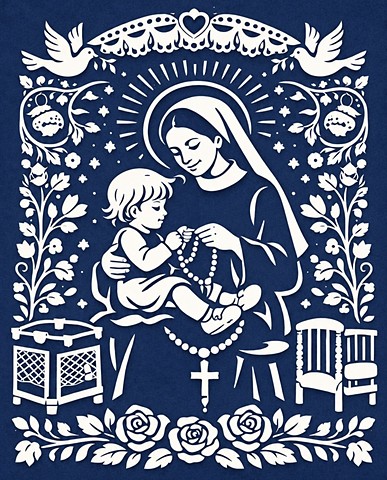
Sister Rhoda, IHM, praying the rosary
Digital design scherenschnitte
Jean-Marie Lee
How to Pray the Rosary
img-cache.oppcdn.com/fixed/9887/assets/…
Why Pray Or Even Say the Rosary
By Jean-Marie Lee
You can evacuate a mega-scale natural disaster, and still, just a few weeks later, find yourself running for your life from a sudden tornado. You can pack up what little you have left, move to an entirely unfamiliar city to start over, and discover that your new roommate’s sole concept of being cordial is offering you a toke of his blunt. The next morning, you step outside into the bitter cold, only to find the entire street blocked off because a human being has jackknifed, jumping to their own death onto the pavement. You have no money, your bank account is empty, and you are shivering uncontrollably because you are from the South—where coats are simply not made the same way they are up north.
In that exact convergence of chaos, you are stripped of every superficial illusion of control. Human justice is nowhere to be found, and the ledger of the world is completely unbalanced by the sight of that street. In that freezing morning air, your mind hits a sharp, structural fork in the road. You can choose to be profoundly grateful that you are alive to feel the cold, or you can choose to look at that pavement and believe that existence is entirely hopeless, cruel, and pointless.
Which way your mind bends in that moment is not a matter of random chance. It is determined by the specific, gritty habits that shape your perspective. When the external world offers no warmth, no easy answers, and literal destruction at your feet, believing in God ceases to be an abstract philosophical luxury—it becomes a conscious, deliberate choice. Practicing Catholicism is a choice. Sitting down to pray the Rosary is a choice. And when the traditional structures around you fail to make sense, it is another distinct choice to look past the superficial marketing, open up the history, and investigate what the Rosary actually is—and what its specific, ironclad promises guarantee to a soul under siege.
In that freezing morning air, staring at a street blocked off by a final act of human despair, you realize that the world’s safety nets are completely gone. You are left with nothing but the rawest elements of human survival. And looking back, you can at least say this for the immediate reality of the room you left behind: at least your roommate shared. It wasn't a pristine, holy gesture, and it wouldn't pass muster in a cathedral or a radical political pamphlet, but it was a basic, unvarnished offer of hospitality from one broke person to another. It was a tiny shred of human connection in a landscape that felt entirely lawless.
But while a shared blunt might carry you through a single freezing evening, it cannot save a mind from bending toward total nihilism when confronted with the pavement the next morning. Small, earthly crumbs of comfort are not enough to rebuild a shattered interior architecture. For that, you need a blueprint that is structural, protective, and unyielding.
That is the exact moment where the Fifteen Promises of the Rosary cease to be a passive, sentimental ritual and become a defensive weapon.
When you actually open up the history and look at what Mary promised to those who pray the Rosary, you realize it is not a call to romanticize the misery or look for a magical exemption from the cold. Instead, the promises read like an ironclad contract for survival under siege. The very first promise guarantees a "signal grace" and a powerful armor against ruin. It does not promise that the street will be clean, or that the coat will suddenly be warm, or that people will stop jumping from buildings. It promises that your soul will be protected from the corruption and the despondency of the environment. The beads become a physical, spatial discipline—a rhythmic boundary line you draw between your mind and the surrounding chaos.
The truth is, my life has been blessed beyond measure since long before I was even conceived. Before I drew my first breath, my Godfather—who was a priest—and several Immaculate Heart of Mary sisters were already actively praying the Rosary for my soul. That is a protective network that space and time cannot touch. And it is not unique to me; there are sisters, brothers, and priests all over this world constantly praying for all of us, acting as quiet spiritual mothers and spiritual fathers to souls they may never physically meet. They say the Rosary, day in and day out, holding up the heavy ceiling of the world.
I carry a glittering memory from my childhood at the Holy Family nursery: sitting and rocking with Sister Rhoda, IHM, the physical rhythm of the chair matching the steady cadence of the prayers as we said the Rosary together. That same rhythm moved to the floor of my childhood living room, where I sat alongside my mother and siblings, moving our fingers from bead to bead.
Our house wasn’t a quiet sanctuary; it was a loud, unpredictable landscape where things could get completely chaotic. I didn't fully understand the complex theological situation surrounding the Our Lady of Medjugorje devotions that took over our home, but I remember a week where our front door was thrown wide open to flocks of pilgrims coming in just to pray. They didn’t just rattle off a polite, single decade to be courteous; they prayed the entire thing—all fifteen decades, the full litany, an unbelievable, exhausting marathon of vocal and mental prayer that filled the rooms.
Have I strayed from my faith at times? Have I had doubts, thrown punches at the dark, and questioned meaning, purpose, and everything else under the sun? Sure. I have spent years trying to intellectually dissect realities that are ultimately too sublime for my own all-knowing arrogance.
But if I didn’t have the Rosary laid down as one of the very first, protective layers of my mind, I probably would have fallen a lot further into the thickets and brambles than I did. It functions as an internal architecture. I am profoundly grateful for the geometry of it, just as I am grateful that my birthday lands on October 13—the feast of Our Lady of Fatima’s Miracle of the Sun. Every few years, that date falls on a Friday, and it becomes a conscious, defiant choice to deny a fictional horror story like Jason Voorhees the right to celebrate blood and terror on my birthday. I choose the Miracle of the Sun instead.
This defensive structure isn't exclusive to Catholicism. The instinct to use repetitive prayer to tether the wandering mind to the divine is an ancient, cross-cultural human anchor. Prayer beads themselves track back to early Hindu and Buddhist malas centuries before the dawn of Christianity or Islam. While Christians and Muslims eventually transitioned from counting prayers on their fingers or with loose piles of pebbles to structured prayer cords, Judaism carved out a different path. Rather than carrying a separate strand of beads, observant Jews look to the corners of their garments, using the tightly knotted fringes of the tzitzit as their physical reminders of the divine.
Yet, Jews and Catholics trace their spiritual lineage back to the exact same literary source: the Psalms. The Rosary’s original structure of 150 prayers was explicitly designed as a "layman’s psalter," mirroring the 150 Psalms of the Bible for ordinary people who couldn't read. Ultimately, the Psalms serve as the universal blueprint for processing trauma, holding space for raw rage, abandonment, despair, and triumph. If you ever find yourself trapped in a bad situation and your own words fail you, you don't need to invent a new philosophy. You just go read the Psalms.
To understand how this mental armor functions when the street outside is blocked off by despair, one must look past the external beads and enter the actual rooms of the prayer: the Mysteries, the Promises, and the Method.
The Rosary is divided into four structural sets of five mysteries, mapping out the human and divine experience. The Joyful Mysteries, prayed on Mondays and Saturdays, focus on grace entering an ordinary world through the early life of Christ. The Luminous Mysteries, prayed on Thursdays, shed light on public ministry, clarity, and truth. The Sorrowful Mysteries, prayed on Tuesdays and Fridays, directly confront raw human suffering, physical isolation, and systemic injustice. The Glorious Mysteries, prayed on Wednesdays and Sundays, serve as a final blueprint of hope, showing that destruction, death, and earthly trials never have the final word.
The promises of the Rosary form an ironclad defense. They are a contract for survival under siege.
The first promises guarantee signal graces and special protection. They provide an armor against hell that destroys vice, stops sin, and defeats heresies.
Next, virtue and good works start to flourish. God’s mercy pours out. The heart turns away from empty vanities and looks toward eternity.
Under the fifth and sixth promises, you will never perish. Misfortune cannot conquer you. God stays His hand of justice, protecting the devout from a sudden, unprovided death.
The seventh and eighth promises secure the final sacraments. You receive the light of grace and share in the merits of the saints in paradise.
The arc pushes further. It pulls souls out of purgatory and guarantees glory in heaven. It unlocks answers to your prayers, secures help in daily needs, and enlists the entire celestial court to intercede for you at the hour of death.
Finally, the fourteenth and fifteenth promises seal the whole structure. They make you a child, sister and brother of Christ. They stand as the ultimate sign of predestination.
The practice relies on a physical layout of space, sequence, and steady rhythm. You start at the crucifix, making the sign of the cross and kissing Jesus on the cross because He forgave everybody who crucified Him—which is pretty generous considering how that went down. Then you say the Apostles' Creed, an Our Father, and three Hail Marys for an increase in the virtues of faith, hope, and charity, followed by a Glory Be and the Fatima prayer.
Then you announce out loud the first decade of the rosary, naming the mystery, like “the Resurrection.” You state the fruit of the mystery—“faith”—and then you say an Our Father while thinking about all the faith it takes to forgive everyone and how much faith it takes just to get out of bed each morning and face the day. Next come the ten Hail Marys. That can sound monotonous, but while you say them, you are supposed to let your mind muse upon the faith of the resurrection and how nice it was of Mary Magdalene to tell everyone instead of keeping it to herself. You are not supposed to just let your mind go adrift thinking about Jersey Mike's subs losing flavor to private equity, or the fact that Celine Dion only seems to have concerts in France. You say the ten Hail Marys meditating on the fruits of the mystery and the mystery itself.
After that, you say a Glory Be and the Fatima prayer, and then you move on to the next mystery. When you finish the last decade, you say the Hail, Holy Queen, followed by the traditional closing Rosary prayer to obtain the gifts the mysteries contain. From there, you say the Litany of Loreto, and you can either end with your special intentions or begin with them right out of the gate. Because once you map out that sequence, it stops being just a religious exercise and becomes a portable defense system—something you can take anywhere, even into the passenger seat of a moving car.
One of the Uber drivers who drives me regularly prays his Muslim prayer cord as he navigates the streets. There is something intensely comforting in this profound, quiet act of public prayer. We do not practice the same religion, but sitting in the backseat watching his fingers move, I get it completely. Everyone should pray as they drive. It transforms a vulnerable, mechanical box into a moving sanctuary, drawing a line of protection between the driver and the erratic indifference of the road.
This daily accounting of grace is an old currency. Sister Veronica, CSC, used to tell me with complete seriousness that her own car had 200,000 Dolors on it. Only a Catholic religious sister would ever calculate vehicle mileage in terms of the Sorrows of Mary, measuring wear and tear by the weight of persistent devotion. But it makes me wonder how that conversation would expand if the dashboard became a shared marketplace of the spirit. A witty Muslim Imam might look across the seat and say, "Impressive, Sister, but I’ve got 200,000 Hasanat on my dashboard. My misbaha gets way better mileage than your dolors!" And if a Rabbi entered the dialogue, he would surely clear his throat and say: "You think that's wealth? If I count all the knots and strings on the tallit in my trunk, I have enough compound spiritual interest to buy out both your vehicles. I’ll see you at the dealership!"
It is a beautiful thing to pray, and it is a beautiful thing to measure life by this hidden, indestructible capital. This is where the trap of performance-based suffering and the romanticization of poverty finally dissolve. True spiritual survival does not require us to wallow in a self-sustained lifestyle of misery for the sake of art, nor does it ask us to put on a show of our vulnerability to manipulate an audience. The driver with his misbaha, the sister counting her Dolors, and the ordinary soul moving a thumb across a wooden bead are not looking for an audience. They are doing the hard, silent, unromantic labor of keeping their minds from shattering against the asphalt.
We do not have to live as passive victims of a lawless environment, nor do we have to pretend that the cold streets or the structural injustices of this world are noble or aesthetic. Human justice will consistently fail to balance the ledger, and the world will continue to offer nothing but crumbs. But when you lay down prayer as the first, foundational layer of your consciousness, you carry your own architecture with you. You realize that the true measure of a life is not found in the empty accolades of a system or the superficial metrics of the world, but in the quiet, defiant mileage of grace that keeps your soul whole until you finally reach home.
Posted on: Tuesday, September 22, 2026