MY OPINION ESSAYS
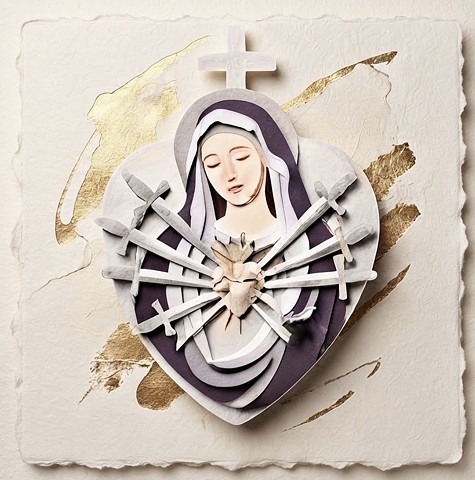
Our Lady of Sorrows, Jean-Marie Lee, 2026
THE CULTURE SHOCK OF VATICAN II IN MOBILE, ALABAMA
By Jean-Marie Lee
When people think of the American Bible Belt, they usually picture an overwhelmingly Protestant world of Baptist and Methodist churches. However, Mobile, Alabama, is a fascinating historical exception. Because it was originally settled by French Catholic colonists in 1702, the Mobile Bay area has a rich, multi-ethnic Catholic heritage that predates the United States itself. For centuries, this diverse community was anchored by the Latin Mass. Conducted in a formal liturgical language, it acted as a powerful equalizer. Rich or poor, white or Black, native or immigrant, everyone knelt together in shared reverence.
However, in the 1960s, a historic global meeting called the Second Vatican Council (Vatican II) turned the Catholic world upside down. The Church chose to modernize essentially phasing out the Latin Mass, instructing priests to face the congregation, incorporating contemporary instruments, and encouraging local cultures to blend their indigenous traditions into worship. In Mobile, these shifts did not just alter Sunday routines—they caused a profound culture shock that collided directly with the Civil Rights Movement, the Vietnam War, and deep-seated local traditions.
For traditional white Catholics in Mobile, Vatican II felt like a spiritual earthquake. Led for decades by the strict Archbishop Thomas J. Toolen, the local diocese was built on rigid, top-down authority. For these families, the mysterious Latin Mass provided a distinct cultural boundary separating them from the surrounding Protestant majority. When English replaced Latin and folk-style music entered the sanctuary, many traditionalists felt the sacred mystery of the Church had been compromised.
To make the transition even more intense, this liturgical shift coincided with Archbishop Toolen's push to desegregate local Catholic schools and parishes. Archbishop Thomas J. Toolen actually integrated Mobile's Catholic schools earlier than local public schools—specifically ordering the desegregation of Spring Hill College in 1954 and Catholic high schools in 1964. Vatican II opened in 1962 and closed in 1965– meaning Archbishop Toolen’s desegregation and integration mandates were well ahead of the close of Vatican II. Toolen was known as a strict traditionalist who dragged his feet on some post-Vatican II liturgical changes. He was not an eager champion of the modernizing council. He retired in 1969, largely weary of the liturgical shifts. For a conservative white establishment, adjusting to the dismantling of Jim Crow segregation while simultaneously watching their ancient religious rituals transform created a period of acute cultural friction that fractured several historic parishes.
While traditional white enclaves reeled from the changes, Mobile's African-American Catholic communities experienced Vatican II as a long-overdue liberation. Before the council, Black Catholics in downtown hubs like Most Pure Heart of Mary parish often had to navigate Eurocentric worship styles that overlooked their cultural heritage. Vatican II introduced "inculturation"—the official principle that the Mass should resonate with the cultural genius of local peoples.
Black parishes along the Gulf Coast were permitted to bring their cultural heritage to the altar, integrating Gospel music, traditional spirituals, and expressive preaching styles directly into the liturgy. A few miles north in Africatown—the historic community founded by the West African survivors of the illegal slave ship Clotilda—this spiritual evolution echoed across local missions, bridging historical divides among Black Christians in the Deep South.
Deep in the rural pine woods of northern Mobile and southern Washington counties, the MOWA Band of Choctaw Indians experienced Vatican II through the lens of cultural preservation. Descending from Choctaw and Creek refugees who hid in the river swamps to escape forced removal, the community faced intense discrimination during the Jim Crow era. Because local institutions often operated on a strict binary racial classification, dark-skinned Native Americans frequently found themselves marginalized by state record-keeping.
Seeking sanctuary, these families found a home in rural Catholic missions like St. Peter's Catholic Church in Chastang. When public options failed to serve their children adequately, the Catholic Diocese stepped in to build parochial schools for them. Post-Vatican II inculturation allowed the MOWA Choctaw to bring elements of their native identity into the open, blending traditional tribal elements into local parish life.
This Catholic bond stands in contrast to Alabama's federally recognized tribe, the Poarch Band of Creek Indians in Atmore. The Poarch Creeks successfully documented their ancestry to the federal government, but because they were surrounded primarily by British Protestant settlers rather than French-Creole ones, they integrated historically with Methodist and Baptist traditions. Their history demonstrates that Catholicism wasn't an inevitable outcome for Gulf Coast natives, but a specific spiritual sanctuary chosen by isolated clans.
To fully understand Mobile's spiritual landscape, one must also examine how these cultures converge during Carnival season. Mobile hosts a massive, multi-week celebration of parades, masks, and secret societies. While tourists see a festive street party, the underlying energy of Mardi Gras is deeply tied to historical African-American cultural resilience. When the Clotilda passengers arrived, they preserved memories of African heritage. In Protestant-dominated areas, alternative spiritualties were heavily suppressed, but in Catholic Mobile, celebratory performance found a natural home within the theatrical framework of Carnival.
The "Mystic Societies" driving the Mardi Gras parades mirror ancient traditions of masking and social inversion. For generations, practitioners of local folk healing and rootwork quietly operated alongside the parish structure, blending syncretic elements with Catholic iconography. When Vatican II modernized the Mass, it shifted the parish liturgy toward a streamlined, vernacular model, causing local spiritual practices to assert themselves even more vibrantly in the public sphere. Post-Vatican II Mardi Gras evolved into a living theater where Black marching bands, native traditions, and old-world Creole mysticism created an alternative cultural landscape celebrating mystery, pageantry, and polyrhythmic music.
During this same era of upheaval, a sharp socioeconomic divide played out in Mobile’s high schools due to the Vietnam War. For working-class families whose children attended public high schools like Mary G. Montgomery, the military draft was an immediate, looming threat. Under selective service rules, full-time college students could secure 2-S deferments, legally delaying military service.
Because attending private Catholic high schools like the McGill Institute required tuition, student bodies there frequently came from families with a direct pipeline to higher education, allowing graduates to transition smoothly to universities and avoid immediate conscription. Meanwhile, working-class public school students who could not afford college faced 1-A classification. Military recruiters targeted public campuses more aggressively, leaving a lasting generational awareness regarding how institutional access dictated who went to war and who stayed home.
To counter any local perception that Catholics were unpatriotic, the post-Vatican II community pivoted toward hyper-patriotic civic mobilization. Catholic men flooded into organizations like the Knights of Columbus, turning them into strongholds of discipline and civic order.
This defensive cultural mobilization paved the way for the rise of Rear Admiral Jeremiah Denton. Shot down over North Vietnam in 1965—the year Vatican II concluded—Denton survived over seven years as a prisoner of war, famously blinking "T-O-R-T-U-R-E" in Morse code during a televised propaganda broadcast. When he returned home to Mobile in 1973, he became a unifying figure for local traditionalists, proving that a devout Catholic could emerge as a prominent American war hero.
In 1980, Denton made history by becoming the first Republican and the first Roman Catholic elected to the U.S. Senate from Alabama since Reconstruction. By championing a conservative platform, Denton built a political bridge between Mobile's traditionalist Catholic networks and the emerging Evangelical New Right of the Bible Belt, proving that the culture shock of Vatican II propelled Mobile’s Catholics directly into the halls of national political power. Denton’s prolife agenda, while undoubtedly traditional Catholicism, fueled a rigid social environment where adult women—whether openly feminist or quietly independent—navigated a culture that expected them to conform to traditional submissiveness.
This societal pressure had real, human costs. I know this reality intimately as I was born posthumously in 1981 to a mother who was a public school teacher and a father who was a Navy Vietnam veteran. Growing up, the shadow of that era hung heavily over our home. In a climate where public opinion still whispered that a woman's place was in the background, my mother quietly bore the grief of a military widow without displaying my father's casket flag or engaging the noisy peanut gallery of local judgment. She focused instead on her education and her career, refusing to let a rigid social framework define her, even as the political and religious establishment around her demanded conformity.
Today, the long-term fallout of these historic shifts can be seen along the coast in places like Bayou La Batre. During the late 20th century, a wave of Vietnamese Catholic immigrants settled along the coast to work in the commercial fishing and shrimping industry. Thanks to Vatican II’s allowance of vernacular liturgies, these families established autonomous, Vietnamese-language parishes, utilizing the modern Church to preserve their distinct cultural identity. Every May, this commercial fishing community gathers for the Blessing of the Fleet—a post-Vatican II ritual where local clergy bless the multi-million-dollar shrimping vessels to ensure a safe and bountiful harvest.
Ultimately, the coastal waters of Mobile remain a living theater of the post-Vatican II era. Even military recruitment patterns came full circle. By the late 1990s, the all-volunteer military began actively recruiting at Catholic high school career nights, courting elite cadets and technical officers. From the pageantry of Mardi Gras and the political legacy of Jeremiah Denton to the thriving parishes of Bayou La Batre, Mobile demonstrates that while the language of the altar can change, the deeply ingrained cultural traditions of its people endure.
Posted on: August 3, 2026