MY OPINION ESSAYS
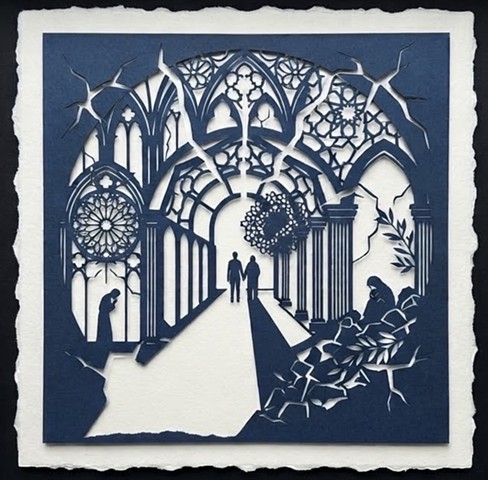
PRUSSIAN BLUE PAPER STUDY: Abrahamic Religions
Digital design, precision-cut 100lb cotton rag, mounted on Arches cold press watercolor paper
1/1, July 7, 2026, Jean-Marie Lee
The Architecture of Anxiety: Faith, Identity, and the Great Fragmentation
By Jean-Marie Lee
The modern era is defined by a pervasive "architecture of anxiety." In a global landscape marked by shifting geopolitical spheres and the decay of traditional institutional authority, individuals are increasingly retreating into ideological and theological silos. Across the Abrahamic traditions—Catholicism, Judaism, and Islam—this retreat is not merely an expression of piety; it is a defensive reaction to a world that feels increasingly volatile, disconnected, and devoid of a shared, stable future.
The Catholic Struggle: Authority and Fragmentation
Within the Catholic Church, the friction between traditionalism and formal institutional authority has reached a boiling point. The recent schism involving the Society of Saint Pius X (SSPX) and the suppression of the Mission of Divine Mercy underscore a crisis of obedience. For many younger Catholics, the appeal of traditional liturgy—such as the Latin Mass—is not purely aesthetic; it is a structural rejection of the perceived fluidity of modern life. In a world where secular institutions and even modern ecclesiastical structures feel unstable, these movements offer the allure of "objective truth" and ancient continuity.
Conversely, the Church is simultaneously struggling with an internal demographic and vocational decline. As secular spheres provide women with autonomy and professional pathways once reserved for religious life, the traditional convent model faces an existential challenge. This reflects a broader "demographic winter" where falling birth rates and the prioritization of professional survival over child-rearing create a sense of societal fragility, leading young people to look to the past to reclaim a sense of permanence.
The Jewish Experience: Between Confidence and Retreat
Jewish identity in 2026 is undergoing a profound bifurcation. On one hand, there is a marked trend of assimilation and distancing from traditional Jewish peoplehood, particularly among younger generations in the Western diaspora. For many, political and social pressures—including the desire to align with narratives of "the oppressed"—have led to a shedding of Jewish particularism. In academic and progressive spaces, the moral cost of identifying with Jewish sovereignty has, for some, become a catalyst for adopting anti-Zionist frameworks, effectively opting out of traditional communal commitments.
Simultaneously, the Orthodox community remains a notable exception to these trends of decline. By prioritizing high levels of religious literacy, strong communal cohesion, and intentional transmission of tradition, Orthodox groups are seeing growth. This highlights the "exception" factor: while secularized segments of the faith drift toward the "nones" or alternative ideological frameworks, those who embrace rigid, high-commitment expressions of the faith are increasingly isolated from the broader, more assimilated demographic trends.
The Palestinian Perspective: The Plight of Existential Insecurity
The Palestinian experience, firmly rooted in the Abrahamic landscape, is defined by a unique and acute form of existential anxiety. Unlike the ideological debates occurring in Western religious institutions, the Palestinian plight is visceral, shaped by displacement, restricted access to life-sustaining resources, and the erosion of a viable future state. Since the regional escalations of 2026, the humanitarian landscape—particularly in the West Bank and Gaza—has been characterized by a loss of agency.
For Palestinians, the "threat of disappearance" is not a metaphor for demographic decline; it is a lived reality of settler violence, systemic displacement, and the breakdown of local infrastructure. While Western religious groups debate doctrines or theological aesthetics, the Palestinian struggle centers on the right to physical existence and historical continuity in their own land. The persistent instability of the region, combined with the failures of international diplomacy, creates a pervasive sense of hopelessness, where the biological and social imperatives to build a future are constantly undermined by the conditions of the present.
The Synthesis: Faith as a Defensive Silo
Across these three traditions, the common denominator is a reaction to the "Mean World Syndrome." When the digital environment keeps individuals in a state of perpetual alarm, the capacity for critical analysis diminishes, and the appeal of "silos" grows. Whether it is the traditionalist Catholic seeking solace in the Latin Mass, the young Jewish activist aligning with radical critiques of their own history to find social belonging, or the Palestinian family struggling to maintain a household under the pressure of displacement, each group is attempting to construct a coherent narrative in a world that refuses to provide one.
Ultimately, the crisis of authority in 2026 is an admission that the grand narratives of the 20th century have collapsed. As these religious groups grapple with drop-outs, internal schisms, and the struggle to retain the next generation, they are each answering the same fundamental question: how does one persist when the institutions meant to protect the future seem to be dissolving? In the absence of a shared global vision, the retreat into specialized, high-commitment silos is not just a trend—it is a survival mechanism.
Posted on: July 7, 2026